 I didn’t come to this work from a distance.
Like many people drawn to questions about relationships, sexuality, and identity, I arrived through the slow realization that the stories I had inherited about love and intimacy didn’t quite explain the complexity of real relational life.
My orientation to this work continues to grow out of a conversation between scholarship, lived experience, and the quiet intelligence of nervous systems that often knows something long before theories catch up.
I am a licensed marriage and family therapist in my third year as a Ph.D. student in Critical Human Sexualities, and I bring over a decade of experience supporting emotional regulation, relational skill-building, and identity development across therapeutic and educational settings.
In my academic life, I study the relational and cultural dimensions of sexuality—particularly within Queer communities, consensual Non-Monogamies, and kink/BDSM spaces. I’m interested in exploring relational ethics and how power, attachment strategies, cultural narratives, and identity formation shape the ways people attempt to love one another. I’m also interested in the places where those narratives start to crack—particularly how people learn to navigate intimacy in a world where the cultural scripts for relationships often feel too narrow for the lives we’re actually living.
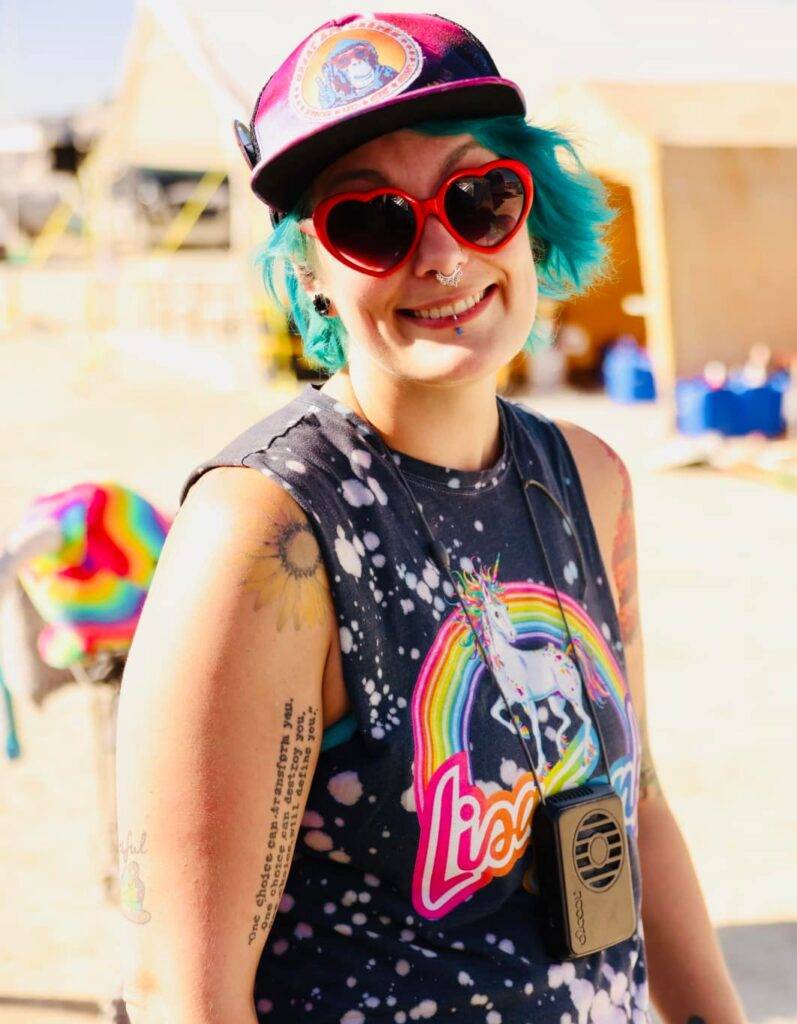
I hold multiple, sometimes conflicting social locations. I am white, mostly able-bodied, and professionally credentialed, and I also move through the world as Queer, Gender-Fluid, NeuroSpicy (or NeuroSparkly, depending on the day), Non-Monogamous, Kinky, and a single parent raising a child who is also AuDHD. These identities shape not only my lived experience, but the lens through which I approach this work—particularly around how power, privilege, stigma, and cultural narratives influence who is allowed to feel “good” or “bad” in relationships, and whose messiness is treated as human versus unacceptable.
I also approach this work as someone practicing both non-monogamy and kink.
What began as specific relational shifts eventually unraveled into something much larger: a confrontation with my attachment patterns, my nervous system, and the inherited beliefs I carried about what love is supposed to look like in order to count as safe, mature, or successful. Living inside those questions (sometimes with clarity, sometimes through jealousy, rupture, grief, and repair) continues to shape how I think about relational responsibility, consent, power, and care.
 Before becoming a therapist, I spent several years working in early childhood education, including as an aide in a day-treatment classroom with autistic preschoolers and later as a preschool teacher. That work centered on emotional regulation, relational attunement, and the slow, patient process of helping developing nervous systems find safety in connection.
Parenting a neurodivergent child has deepened that understanding in ways no professional training ever could. Together, these experiences continue to shape how I hold space now—especially around pacing, accessibility, and the understanding that people enter relational conversations with very different thresholds for risk, visibility, and vulnerability.
Rather than positioning myself as someone who has solved the questions this work raises, I approach them as ongoing sites of inquiry. Scholarship helps. Clinical training helps. Language helps. But insight has never exempted me—or anyone—from grief, fear, jealousy, longing, or uncertainty.
Becoming Otherwise emerged from that recognition: that many of us are trying to navigate love, identity, and intimacy with inherited maps that were never designed for the terrain we actually inhabit.
And that sometimes the most honest thing we can do is pause, look at those maps together and begin asking better questions.
Most of the work begins there — in the willingness to stay with the questions.
I didn’t come to this work from a distance.
Like many people drawn to questions about relationships, sexuality, and identity, I arrived through the slow realization that the stories I had inherited about love and intimacy didn’t quite explain the complexity of real relational life.
My orientation to this work continues to grow out of a conversation between scholarship, lived experience, and the quiet intelligence of nervous systems that often knows something long before theories catch up.
I am a licensed marriage and family therapist in my third year as a Ph.D. student in Critical Human Sexualities, and I bring over a decade of experience supporting emotional regulation, relational skill-building, and identity development across therapeutic and educational settings.
In my academic life, I study the relational and cultural dimensions of sexuality—particularly within Queer communities, consensual Non-Monogamies, and kink/BDSM spaces. I’m interested in exploring relational ethics and how power, attachment strategies, cultural narratives, and identity formation shape the ways people attempt to love one another. I’m also interested in the places where those narratives start to crack—particularly how people learn to navigate intimacy in a world where the cultural scripts for relationships often feel too narrow for the lives we’re actually living.
I hold multiple, sometimes conflicting social locations. I am white, mostly able-bodied, and professionally credentialed, and I also move through the world as Queer, Gender-Fluid, NeuroSpicy (or NeuroSparkly, depending on the day), Non-Monogamous, Kinky, and a single parent raising a child who is also AuDHD. These identities shape not only my lived experience, but the lens through which I approach this work—particularly around how power, privilege, stigma, and cultural narratives influence who is allowed to feel “good” or “bad” in relationships, and whose messiness is treated as human versus unacceptable.
I also approach this work as someone practicing both non-monogamy and kink.
What began as specific relational shifts eventually unraveled into something much larger: a confrontation with my attachment patterns, my nervous system, and the inherited beliefs I carried about what love is supposed to look like in order to count as safe, mature, or successful. Living inside those questions (sometimes with clarity, sometimes through jealousy, rupture, grief, and repair) continues to shape how I think about relational responsibility, consent, power, and care.
Before becoming a therapist, I spent several years working in early childhood education, including as an aide in a day-treatment classroom with autistic preschoolers and later as a preschool teacher. That work centered on emotional regulation, relational attunement, and the slow, patient process of helping developing nervous systems find safety in connection.
Parenting a neurodivergent child has deepened that understanding in ways no professional training ever could. Together, these experiences continue to shape how I hold space now—especially around pacing, accessibility, and the understanding that people enter relational conversations with very different thresholds for risk, visibility, and vulnerability.
Rather than positioning myself as someone who has solved the questions this work raises, I approach them as ongoing sites of inquiry. Scholarship helps. Clinical training helps. Language helps. But insight has never exempted me—or anyone—from grief, fear, jealousy, longing, or uncertainty.
Becoming Otherwise emerged from that recognition: that many of us are trying to navigate love, identity, and intimacy with inherited maps that were never designed for the terrain we actually inhabit.
And that sometimes the most honest thing we can do is pause, look at those maps together and begin asking better questions.
Most of the work begins there — in the willingness to stay with the questions.
What does it mean to practice something that never quite stabilizes?
That’s the question that keeps returning for me.
Because the forces that shape relational life (attachment, desire, power, autonomy, shame, longing, etc.) rarely behave like tidy concepts once they’re actually lived. They move. They contradict themselves. They show up differently in the body than they do in theory.
So this section isn’t a declaration of expertise. It’s a glimpse into the questions I continue to practice living inside.
Much of what informs my work emerges from the tension between ideas and lived relational life. Theory can help us name patterns, but relationships tend to unfold in ways that refuse neat explanations.
Insight might arrive quickly; integration rarely does.
Over time, I’ve become less interested in identifying the “right” way to structure relationships and more interested in the processes that shape how people move through them.
For me, Non-Monogamy has functioned not just as an identity, but also as an ongoing relational practice—one that exposes attachment strategies, cultural expectations around scarcity and ownership, and the ways nervous systems attempt to restore safety when love stops behaving predictably.
Kink has offered a different kind of classroom. In many Kink communities, dynamics like power, consent, negotiation, and responsibility must be spoken aloud rather than quietly assumed. Those practices have deeply shaped how I think about relational ethics—not as a set of rules to perform correctly, but as an ongoing practice of attention and accountability.
Much of the inquiry that informs Becoming Otherwise lives at the intersection of several overlapping lenses: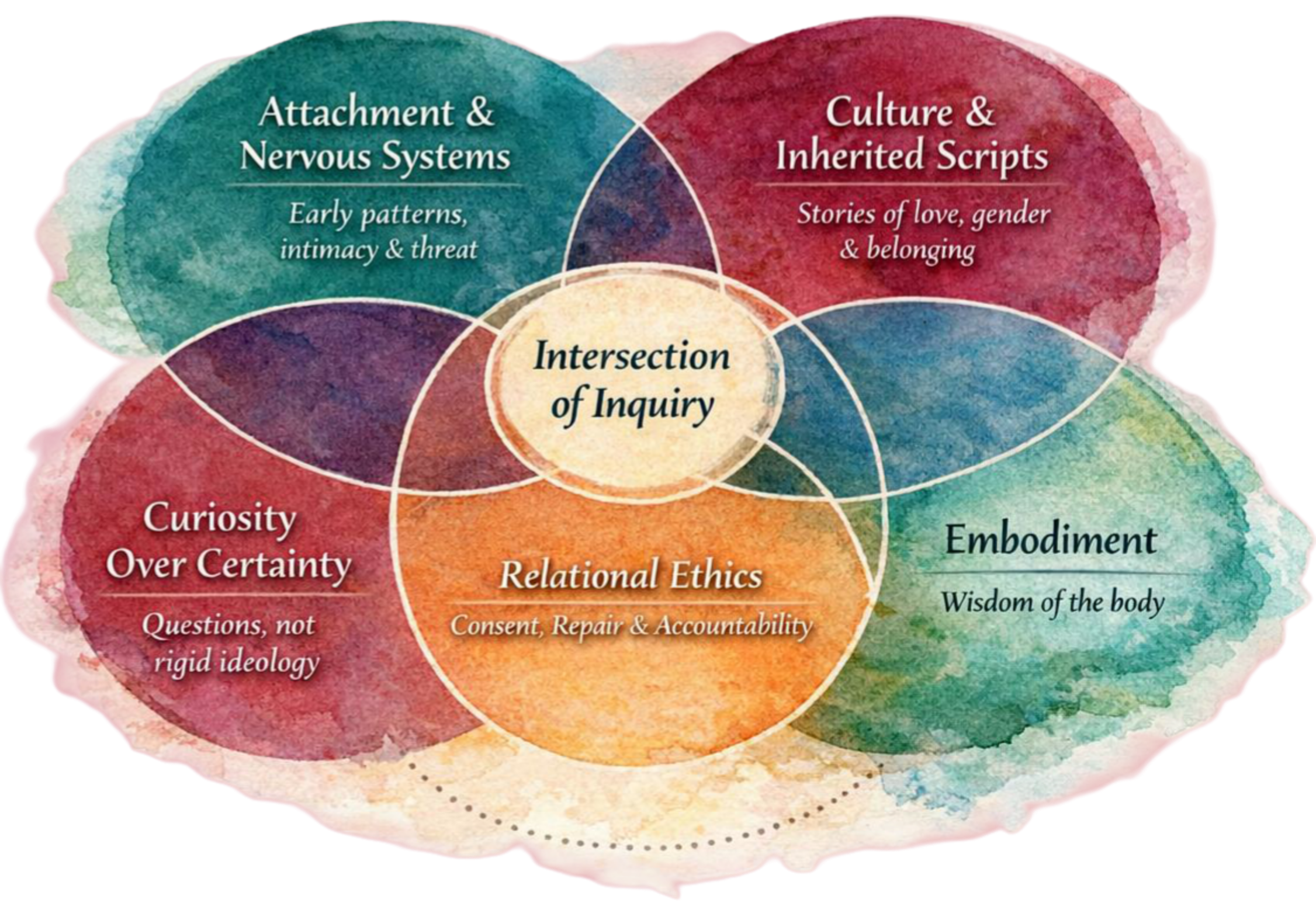 I’m less interested in helping people become “better” at relationships according to someone else’s standard than I am in helping people develop the capacity to notice what is actually happening (internally, relationally, and culturally) and to respond with more honesty and responsibility.

Which means the questions I return to most often are rarely about technique.
They sound more like this:
What is the nervous system trying to protect here?
What story about love is operating beneath the surface?
Who benefits from that story remaining unquestioned?
And what becomes possible when we loosen it, even just a little bit?
Because for many people, the most meaningful shifts in relational life do not come from mastering a new framework.
They come from learning how to stay present in the uneasy space where inherited narratives about love begin to unravel, and where something more honest might start to emerge.
What does it mean to practice something that never quite stabilizes?
That’s the question that keeps returning for me.
Because the forces that shape relational life (attachment, desire, power, autonomy, shame, longing, etc.) rarely behave like tidy concepts once they’re actually lived. They move. They contradict themselves. They show up differently in the body than they do in theory.
So this section isn’t a declaration of expertise. It’s a glimpse into the questions I continue to practice living inside.
Much of what informs my work emerges from the tension between ideas and lived relational life. Theory can help us name patterns, but relationships tend to unfold in ways that refuse neat explanations.
Insight might arrive quickly; integration rarely does.
Over time, I’ve become less interested in identifying the “right” way to structure relationships and more interested in the processes that shape how people move through them.
For me, Non-Monogamy has functioned not just as an identity, but also as an ongoing relational practice—one that exposes attachment strategies, cultural expectations around scarcity and ownership, and the ways nervous systems attempt to restore safety when love stops behaving predictably.
Kink has offered a different kind of classroom. In many Kink communities, dynamics like power, consent, negotiation, and responsibility must be spoken aloud rather than quietly assumed. Those practices have deeply shaped how I think about relational ethics—not as a set of rules to perform correctly, but as an ongoing practice of attention and accountability.
Much of the inquiry that informs Becoming Otherwise lives at the intersection of several overlapping lenses:
I’m less interested in helping people become “better” at relationships according to someone else’s standard than I am in helping people develop the capacity to notice what is actually happening (internally, relationally, and culturally) and to respond with more honesty and responsibility.
Which means the questions I return to most often are rarely about technique.
They sound more like this:
What is the nervous system trying to protect here?
What story about love is operating beneath the surface?
Who benefits from that story remaining unquestioned?
And what becomes possible when we loosen it, even just a little bit?
Because for many people, the most meaningful shifts in relational life do not come from mastering a new framework.
They come from learning how to stay present in the uneasy space where inherited narratives about love begin to unravel, and where something more honest might start to emerge.
I think a lot about what it means to create spaces where people can be real without being harmed for it. And I’m intentional about the word safer here. Because no space is perfectly safe. Bodies carry history. Power doesn’t disappear just because we name it.
But there are ways of structuring a room that make more honesty possible. More repair possible. More room to be human without masking or being immediately shut down, judged, or fixed.
In Becoming Otherwise spaces, the goal isn’t agreement. It’s not consensus. It’s not getting everyone to the same conclusion.
It’s creating conditions where complexity can exist without collapse.
Where people can:
- speak from lived experience without needing to translate it into something palatable
- encounter difference without immediately turning it into threat or debate
- notice their own reactions (defensiveness, urgency, withdrawal, certainty) as part of the process—not a failure of it
This means we move slowly enough to notice what’s happening beneath the surface.
Not just what is being said, but:
- how it lands in the body
- what it brings up relationally
- what histories and power dynamics are shaping the moment
Because conversations about sexuality, identity, power, and relationships don’t happen in a vacuum. They happen inside systems. Inside nervous systems. Inside cultural narratives that tell us what is acceptable, desirable, dangerous, or wrong.
Part of my role in these spaces is to hold attention to those layers without collapsing into authority.
I’m not here as the person with the “right” answers.

I’m here to guide the structure of the conversation, name patterns when they emerge, support accountability without shame, make space for repair when rupture happens, and also to notice when the room needs to pause, to slow things down when intensity spikes, and to bring us back to curiosity when certainty starts to harden.
Because nuance requires something many of us were never taught: the capacity to stay present in the middle of contradiction.
To hold:
care and impact – intention and consequence – autonomy and responsibility
without immediately rushing to resolve the tension.
These spaces are participatory.
No one is required to share, but everyone is invited to be in relationship with what’s unfolding.
That might look like speaking.
Or listening.
Or noticing what’s happening internally and choosing what to do with that awareness; because often the choosing is more important than the doing.
I’m less interested in creating spaces where people feel comfortable all the time and more interested in creating spaces where people feel:
- supported enough
- resourced enough
- and oriented enough to stay in the conversation when it matters.
Because something shifts when we realize we don’t actually need perfect language, perfect knowledge, or perfect agreement to be in ethical relationship with each other.
We need presence.
We need practice.
And we need spaces that can hold us while we learn how to do that differently.
And maybe that’s what holding a room is, in the end.
Not making it easier.
But making it possible to stay.
—
And lastly, it’s important to say this clearly:
Becoming Otherwise offers coaching, educational workshops, and facilitated conversations. These offerings are educational and exploratory in nature; they are not psychotherapy, do not involve diagnosis or treatment, and do not establish a therapeutic relationship.
I think a lot about what it means to create spaces where people can be real without being harmed for it. And I’m intentional about the word safer here. Because no space is perfectly safe. Bodies carry history. Power doesn’t disappear just because we name it.
But there are ways of structuring a room that make more honesty possible. More repair possible. More room to be human without masking or being immediately shut down, judged, or fixed.
In Becoming Otherwise spaces, the goal isn’t agreement. It’s not consensus. It’s not getting everyone to the same conclusion.
It’s creating conditions where complexity can exist without collapse.
Where people can:
- speak from lived experience without needing to translate it into something palatable
- encounter difference without immediately turning it into threat or debate
- notice their own reactions (defensiveness, urgency, withdrawal, certainty) as part of the process—not a failure of it
This means we move slowly enough to notice what’s happening beneath the surface.
Not just what is being said, but:
- how it lands in the body
- what it brings up relationally
- what histories and power dynamics are shaping the moment
Because conversations about sexuality, identity, power, and relationships don’t happen in a vacuum. They happen inside systems. Inside nervous systems. Inside cultural narratives that tell us what is acceptable, desirable, dangerous, or wrong.
Part of my role in these spaces is to hold attention to those layers without collapsing into authority.
I’m not here as the person with the “right” answers.
I’m here to guide the structure of the conversation, name patterns when they emerge, support accountability without shame, make space for repair when rupture happens, and also to notice when the room needs to pause, to slow things down when intensity spikes, and to bring us back to curiosity when certainty starts to harden.
Because nuance requires something many of us were never taught: the capacity to stay present in the middle of contradiction.
To hold:
care and impact – intention and consequence – autonomy and responsibility
without immediately rushing to resolve the tension.
These spaces are participatory.
No one is required to share, but everyone is invited to be in relationship with what’s unfolding.
That might look like speaking.
Or listening.
Or noticing what’s happening internally and choosing what to do with that awareness; because often the choosing is more important than the doing.
I’m less interested in creating spaces where people feel comfortable all the time and more interested in creating spaces where people feel:
- supported enough
- resourced enough
- and oriented enough to stay in the conversation when it matters.
Because something shifts when we realize we don’t actually need perfect language, perfect knowledge, or perfect agreement to be in ethical relationship with each other.
We need presence.
We need practice.
And we need spaces that can hold us while we learn how to do that differently.
And maybe that’s what holding a room is, in the end.
Not making it easier.
But making it possible to stay.
—
And lastly, it’s important to say this clearly:
Becoming Otherwise offers coaching, educational workshops, and facilitated conversations. These offerings are educational and exploratory in nature; they are not psychotherapy, do not involve diagnosis or treatment, and do not establish a therapeutic relationship.